- Command Post
- Posts
- Dispatch #026 | Define The Win
Dispatch #026 | Define The Win
New Year. New Battlefield. Clearer Objectives.

Mike Gorski
January 07, 2026

9 Min Read
“You don’t lose because the game is hard. You lose because you never defined what winning looked like.”
It’s crazy to think we are already a week into 2026.
Looking back at 2025, the scoreboard tells a story worth pausing on.
One of the clearest wins came from the people, not the platforms.
This year, we brought more RevForce Operators to the HighLevel Summit than we did the year prior and that mattered.
Not as a vanity metric, but as proof of momentum. Proof that the bench is getting deeper. Proof that the pipeline is working.
More importantly, every Operator leveled up.
Not just in technical skill but in confidence. Confidence to speak with clarity.
Confidence to price their work appropriately. Confidence to sit across from better clients and hold the line.
As a direct result, we saw something that actually matters. Operators earning better-paying clients because they were operating at a higher standard.
Skill compounds. Confidence compounds. And when those two align, opportunity follows.
That part of 2025? Solid work.
But wins don’t excuse blind spots and leadership doesn’t get a pass on the hard stuff.
As part of our annual AAR (After Action Review), one area stood out to me more than any KPI, dashboard, or growth chart ever could.
Culture.
And I’ll be blunt. The internal culture of 2025 was garbage.
That one’s on me.
When you run hard for two and a half years straight, 10 to 12-hour days, most weekends, putting constant pressure on yourself to “don’t let others down”, burnout stops being a risk and starts becoming a certainty.
And burnout doesn’t just affect output.
It erodes judgment, patience and presence. The very things a leader is supposed to bring into the room.
The consequences are subtle at first. Then they’re not.
Culture is hard to quantify, but its impact can make or break a company faster than any bad quarter ever could. And ignoring that reality is how good teams quietly unravel.
So here’s the commitment and the promise I’m making to the team in 2026.
More strategic breaks for R&R. Not as an indulgence but as a discipline.
Because more is not always more. More is less when it’s intentional.
This year is about defining “the win” more clearly for our business clients, for our Operators and the new recruits training to eventually become Full Stack Operators.
Defining what winning looks like for an individual or organization will be much more feasible when you’re attacking it from a advantage point of clarity.
We don’t move forward pretending 2025 was perfect. We move forward because we learned from it.
And that’s how real progress starts.
“Culture eats strategy for breakfast.”
TL;DR | Quick Brief Links

Mission Debrief: The Broken Chain of Command
On paper, the client relationship was clean. Clear scope. Clear point of contact.
A designated internal lead on their side whose job was to coordinate with our team and funnel requests through the proper channel.
That structure existed for a reason. Then the pattern started to emerge.
Instead of raising an issue internally and allowing their appointed point of contact to engage us, one individual began reaching out directly and to multiple people on the our team asking for the same request.
Same ask. Different inboxes. Zero coordination.
At first glance, it can look like initiative. In reality, it’s something else entirely.
This is communication triangulation.
It’s the quiet erosion of process where one person bypasses the chain of command to apply pressure, accelerate outcomes, or gain leverage.
Not because the system failed but because the system got in the way of what they personally wanted.
Here’s why this matters.
When communication splinters, accountability disappears. When accountability disappears, timelines slip. And when timelines slip, everyone ends up frustrated often without being able to point to a single cause.
No one wins in that scenario.
We don’t assume malice where confusion could exist, but intent becomes clear when the pattern repeats.
Clean systems depend on clean lanes. When someone refuses to use them, they introduce risk into an otherwise stable operation. Risk compounds fast.
There’s a reason mature organizations protect their communication structures. They prevent duplicate work. They preserve trust. They ensure decisions are made with full context instead of partial narratives.
Bypassing that structure doesn’t make things faster. It makes them fragile.
✅ What The Operator Did:
Reasserted the agreed-upon communication protocol without emotion or escalation
Redirected all requests back through the appointed point of contact
Documented the interaction to preserve clarity and continuity
Maintained professional boundaries while keeping the mission moving forward
🔥 Tactical Takeaways (For Business Owners & Internal Teams)
Communication chains exist to protect outcomes, not egos
Triangulation creates speed illusions while quietly increasing risk
One voice to the vendor equals cleaner execution
Respecting process is a sign of operational maturity
If someone keeps bypassing the system, the system isn’t the problem

Here’s the hard truth most teams avoid saying out loud:
Most people don’t lose because they lack effort. They lose because they never agreed on what winning actually meant.
After the AAR, after the culture gut check, after watching both our Operators and our clients navigate friction that had nothing to do with tools, one pattern became impossible to ignore.
Undefined wins create unnecessary conflict.
When the objective is fuzzy, everything feels urgent. When ownership is unclear, communication fractures. When success isn’t defined in advance, every decision turns into a negotiation.
That’s not a people problem. That’s a leadership problem.
So heading into 2026, we’re drawing harder lines. Not necessarily to restrict movement, but to create freedom where it matters.
Winning at RevForce this year looks like this:
Fewer emotional escalations disguised as urgency
Fewer broken chains of command
Fewer “drive-by” requests that bypass systems
More clarity up front
More disciplined execution
More energy preserved for the work that actually moves the needle
This structure is not bureaucracy, it’s protection.
Protection for Operators who need clean lanes to perform at a high level. Protection for clients who want outcomes instead of chaos. Protection for the culture we’re actively rebuilding, intentionally this time.
I’m not interested in building a company that runs on heroics. Heroics burn people out.
Systems scale people up.
That’s the shift.
2026 is the year we stop rewarding noise and start rewarding precision. We stop mistaking motion for progress. We define the win early and then we execute without apology.
Because once the objective is clear, everything else gets quieter.
Let’s go.

Time for your recon drop.
This is Actionable Intelligence that matters, globally and inside the HighLevel war room.

The Hardware Arms Race Just Shifted Gears
The silicon floor just dropped out.
Recently at the Consumer Electronics Show, Jensen Huang stepped on stage and made it official that NVIDIA’s Rubin computing architecture is live, in production, and scaling into the second half of the year.
This is not a roadmap slide. This is hardware already rolling off the line.
Rubin replaces Blackwell, which replaced Hopper, which replaced Lovelace another clean handoff in NVIDIA’s relentless execution cycle that has turned the company into the most valuable corporation on the planet.
Huang put it plainly:
“The amount of computation necessary for AI is skyrocketing. Today, I can tell you that Vera Rubin is in full production.”
Rubin is not a single chip. It’s a six-part architecture designed to work as a coordinated system:
A next-generation Rubin GPU at the core
A new Vera CPU, purpose-built for agentic reasoning
Major upgrades to BlueField (networking)
Major upgrades to NVLink (interconnect)
New external storage tiers designed to handle exploding memory demands
Architecture-level optimization for long-running, multi-step AI workflows
This is NVIDIA explicitly optimizing for agentic AI, not just bigger models.
As workflows move from “single prompt to single response” to long-horizon tasks, memory pressure becomes the bottleneck.
Rubin attacks that problem directly by decoupling and scaling storage in a way prior architectures simply couldn’t.
Why This Matters (For Operators & Small Business Owners)
This is not a hardware story. This is an economics story.
Huang has already estimated $3–4 trillion in AI infrastructure spending over the next five years. Rubin is the platform designed to absorb that demand.
Here’s the signal beneath the noise:
Agentic AI is moving from concept to infrastructure
Long-running, autonomous workflows are becoming the default
Compute efficiency now determines who can afford to compete
Hardware is setting the ceiling for software ambition
For Operators, this means the tools will get faster, cheaper, and more capable whether you’re ready or not.
For business owners, this confirms something critical:
AI is no longer an “add-on.” It is foundational infrastructure on the same level as electricity, logistics, and communications.
The question for 2026 isn’t if AI becomes embedded in your operations.
It’s whether your systems, teams, and decision-making are built to use it intentionally or whether you’ll let raw horsepower dictate outcomes.
Define the win or the hardware will define it for you.

Here are my top three choices from this week’s feature drop.
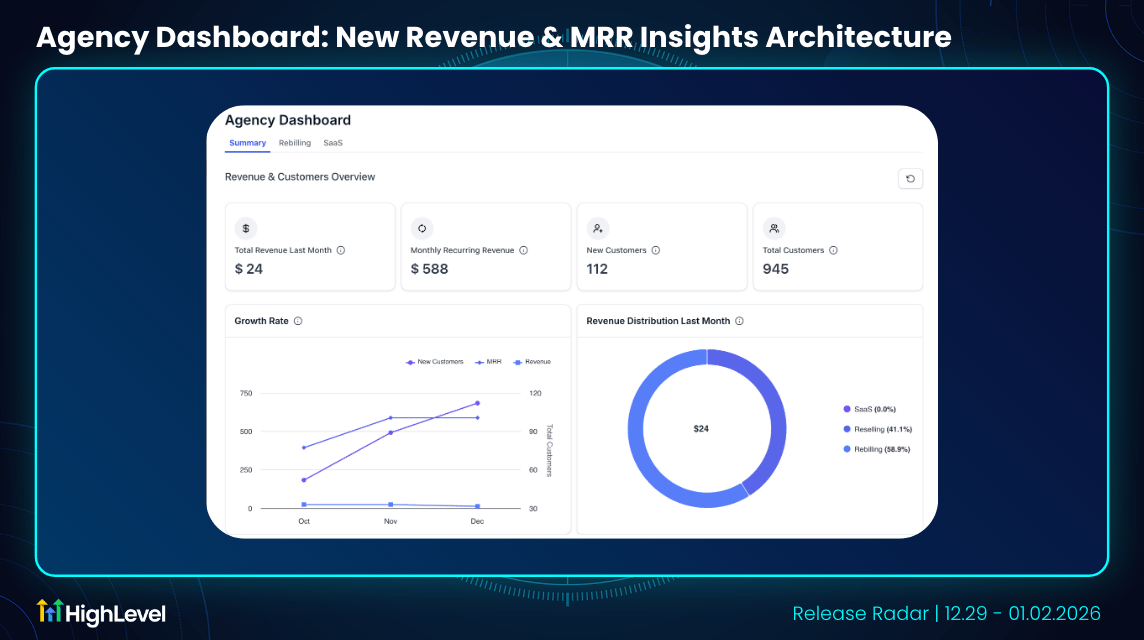
Agency Dashboard: New Revenue & MRR Insight Architecture
Summary tab to ensure agencies have clearer, more accurate, and more reliable visibility into their revenue performance.
With this update, we’ve refined the underlying calculation logic to reflect only HighLevel-backed revenue streams, resulting in numbers you can trust and act on with confidence.
Agent Studio: Brand Voice & Brand Kit Integration
Brand Voice & Brand Kit Integration in Agent Studio empowers your agents to generate content that authentically reflects your business's unique voice, values, and visual identity.

Chat Widget: Expanded Sound Notification for Live Messages
Sound notifications in the Live Chat Widget have been expanded to cover many more system and lifecycle messages, ensuring website visitors don’t miss important updates during a chat session.

📺 Want the Full Feature Breakdown? Watch the full video below 👇️ 👇️👇️
View Google Presentation Slide Deck HERE.

Upcoming HighLevel Live Events
HighLevel Local Hangout | Dallas, TX | January 13th
HighLevel Local Hangout | London, UK | January 21st
HighLevel Local Hangout | Miami, FL | February 16th
RSVP Form Coming Soon

Alright Be Honest, How’d I Do?
Your opinion matters to me.
Seriously. I don’t write this newsletter because I’ve got nothing better to do.
I do it because I am hell bent on building REAL value for you.
Did this Dispatch deliver? Or should I call in an airstrike and start fresh?
Drop a comment or leave some stars
⭐️ ⭐️ ⭐️ Mission Accomplished – Tactical, tight, and ready for deployment
⭐️ ⭐️ Needs Reinforcements – Some hits, but it’s limping
⭐️ Mission Failure – Absolute FUBAR
Until next week,
Stay Frosty!
Michael
Reply