- Command Post
- Posts
- Dispatch #024 | Bangkok, Breakfast, and the Jobless Boom
Dispatch #024 | Bangkok, Breakfast, and the Jobless Boom
The Operator’s Guide to “No Hire, No Fire”

Mike Gorski
December 02, 2025
9 Min Read
“The companies that refuse to fire and refuse to hire still expect the work to get done. The only question is whether they pay a salary for it or wire an Operator.”
By the time you read this dispatch, I’ll be in a room in Bangkok with a cold Thai beer on the desk and the last echoes of a 23-hour flight still rattling around in my spine.
The trip started in Chicago O’Hare, the way a lot of good stories do. Under fluorescent lights and with a winter storm chewing up the runway while disrupting the whole travel logistics while everyone pretended this was fine.
Our flight to Abu Dhabi kept sliding to the right.
First a small delay. Then a bigger one. The kind of delay where you start doing mental math on layovers and whether you’re going to spend the night curled around your backpack at some random gate.
Meanwhile, the departure monitor flickered between statuses like it was gaslighting the entire terminal.
“On Time.” “Delayed.” “New Time Pending.”
Nobody moved. Nobody left. Everyone just simply waited for their next marching orders.
It felt eerily similar to scrolling LinkedIn in 2025.
Corporate America has quietly shifted into a “no hire, no fire” stance.
Roles open, then vanish. Headcount freezes. Teams stay understaffed, but the work stays on the board. The economy grows, but entry points stay locked.
People sit in digital departure lounges, refreshing job boards like a gate screen, hoping the status flips back to “Now Boarding.”
Eventually our plane did board. We took off through the snow, whiteout fading into darkness, then into the kind of dull airplane purgatory where time stretches out like taffy.
Thirteen hours later, we dropped into Abu Dhabi for a three hour layover. Another terminal. Another mass of people in transit. Everyone moving and yet basically nowhere.
Then came the last leg from Abu Dhabi to Bangkok. Six more hours in the sky, a sunrise out the window, and finally, touchdown at Suvarnabhumi at 7:00 AM local time on a Monday.
Bangkok greeted us with rush-hour traffic that felt like someone hit fast-forward on the city. Motorbikes threading through cars, delivery trucks stacked with goods, office workers packed into buses, kids in uniforms clinging to the backs of scooters.
Every lane full. Every human clearly going somewhere.
We grabbed a passenger van, eyes burning but wired, rolling through the city while the dashboard clock taunted us with the hotel breakfast cutoff time.
This is how you know you live in the modern world. You have just crossed the planet, survived a snowstorm delay, cleared immigration, and you are now running a precision time-and-motion operation to make the buffet before they pull the last strip of bacon.
We pulled up to the hotel. Bags dropped with the kind of speed that would impress a pit crew.
Straight to the elevator. Straight to the restaurant. We slid into the breakfast area 30 minutes before cut-off, jet-lagged, half-feral, staring out at Bangkok’s Monday morning chaos with a plate of eggs and rice like we had just completed a successful covert insertion.
That first cup of coffee hit and the contrast snapped into focus:
Outside: a city in full movement.
Back home: An economy where the work keeps coming but the headcount stays frozen.
One environment rewards motion, improvisation, and speed. The other rewards waiting for approvals that never land.
Sitting there in Bangkok, I realized this dispatch needed to draw a hard line between those two operating systems.
On one side, you have the classic playbook:
Update the resume.
Fire off applications.
Pray for a recruiter to rescue you from the gate you’ve been stuck at for months.
On the other side, you have the Operator path:
Take the skills you already carry in your head and hands.
Package them into a clear mission for businesses that still need work done.
Sell outcomes as a B2B service while corporate America plays hiring freeze musical chairs.
The plane doesn’t care what the job market looks like. Bangkok traffic doesn’t pause because HR paused headcount.
Movement exists. Demand exists. Missions exist.
The question this dispatch is going to wrestle with is simple:
In a “no hire, no fire” world, do you keep refreshing the departure board
or do you build your own flight plan, sell a mission, and take off under your own callsign?”
TL;DR | Quick Brief Links

Mission Debrief: The $2,500 Rehearsal That Turned Into $22,000
This week’s field report comes from one of our Operators who just landed their biggest win yet, a $22,000, 2-month contract with a multinational company
Two months earlier, their experience with AWS? ZERO.
Most people see that and tap out. Wrong stack, wrong buzzwords, wrong time.
Our Operator ran a different play.
They sold a $2,500 Process Mapping engagement first, a paid recon mission.
Then they spent two focused weeks learning exactly what they needed to know about AWS to solve the client’s problem.
End result?
✅ What The Operator Did:
Positioned discovery as a paid mission, not a free pre-sales favor.
Committed to learning on the clock.
Delivered an 39 page operator-grade blueprint detailing architecture, risks, steps, and outcomes. This is something the client could feel was battle-tested.
Made the implementation decision a no-brainer. The client saw one person who understood their system better than their own internal team. The natural next step was a 2-month, $22K deployment contract.
🔥 Tactical Takeaways (For Business Owners & Internal Teams)
Get paid for discovery. Turn “free strategy” into a low-ticket Process Map or Audit. That’s your wedge.
Learning speed is the only real edge. You do not need to know everything on day one. You need to learn faster than the situation.
Documentation closes deals. A concrete plan (even 10–15 pages) beats vague “experience” on a resume.
Design step one to make step two obvious. Your mapping offer should make you the default choice to execute.

Sitting at that Bangkok breakfast table, I started researching and scrolling the latest labor data trying to put hard numbers to the “no hire, no fire” feeling.
Here’s the short version:
Layoffs are low, hiring is weak.
U.S. jobless claims just hit about 216,000, a seven-month low. Layoffs stay muted, but economists point out the market isn’t generating enough new jobs, creating exactly the kind of “no hire, no fire” climate job seekers are feeling.
The Fed is literally calling it ‘low-hire, low-fire.’
Federal Reserve reports now describe the 2025 labor market as a fragile “low-hire, low-fire” economy employment drifting sideways as companies freeze hiring or trim hours instead of doing big layoffs.Big companies want growth without headcount.
Wall Street and corporate research notes the new doctrine: “growth without hiring.” Giants like JPMorgan, Walmart, and Meta openly aim to grow revenue while keeping staff flat, leaning on automation and AI instead of adding employees.
From inside the wire at RevForce, that adds up to one clear reality: The work still exists. The missions still exist.
The friction sits at a permanent headcount which is exactly why Operators who sell outcomes as B2B partners have the strategic advantage in this “no hire, no fire” era.
Resources

Time for your recon drop.
This is Actionable Intelligence that matters, globally and inside the HighLevel war room.

OpenAI CEO Sam Altman declares 'code red' as ChatGPT competition mounts
OpenAI just pulled the fire alarm on itself.
Sam Altman sent an internal “code red” memo ordering teams to drop side quests (ads, Pulse, even AI agents) and focus entirely on making ChatGPT faster, more reliable, and more personalized.
The trigger? Google’s Gemini 3 and Anthropic’s Claude Opus 4.5 beating GPT-5 on key benchmarks and stealing mindshare in the enterprise.
OpenAI now projects a jump from roughly $13B in revenue in 2025 to $200B by 2030.
An insane growth target that explains the panic.
Meanwhile, CEOs like Salesforce’s Marc Benioff are publicly declaring they’re “not going back” to ChatGPT after switching to Gemini 3.
Why This Matters (For Operators & Small Business Owners)
The AI race just escalated from “fast” to full combat tempo.
Product roadmaps at the top are now dictated by defensive moves, not just vision.
Enterprise buyers will spread bets across multiple models, not marry one vendor.
The signal under the noise is these platforms will keep punching each other in the face.
The real opportunity is building systems, offers, and Operator teams on top of whichever model wins for a specific mission.

Here are my top three choices from this week’s feature drop.
Conversations: Google Review Responses Report
You ca now respond directly to Google My Business (GMB) reviews from within the revamped Conversations UI, making it easier to engage with customer feedback in one place.

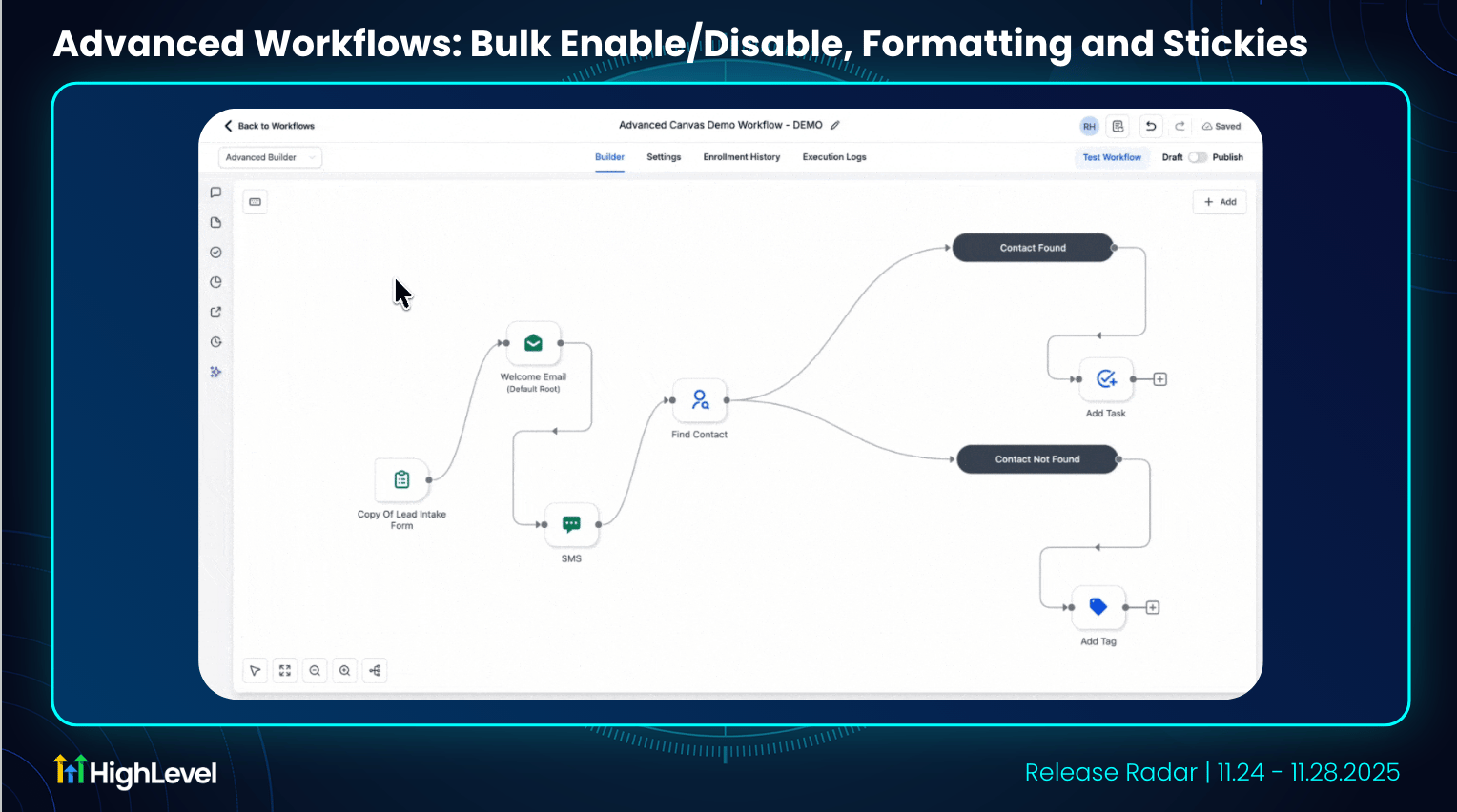
Advanced Workflows: Bulk Enable/Disable Formatting & Sticky Notes
Bulk enable/disable selected nodes: Toggle entire sections on or off from the selected area - great for disabling branches.
Format only the selected area: Snap spacing, align connections, and clean up just the portion you selected for an organized canvas.
Add a sticky note to a selection: Quickly add and label sticky notes for selections using right-click options.
Workflows: GPT-5 Action Enhancement
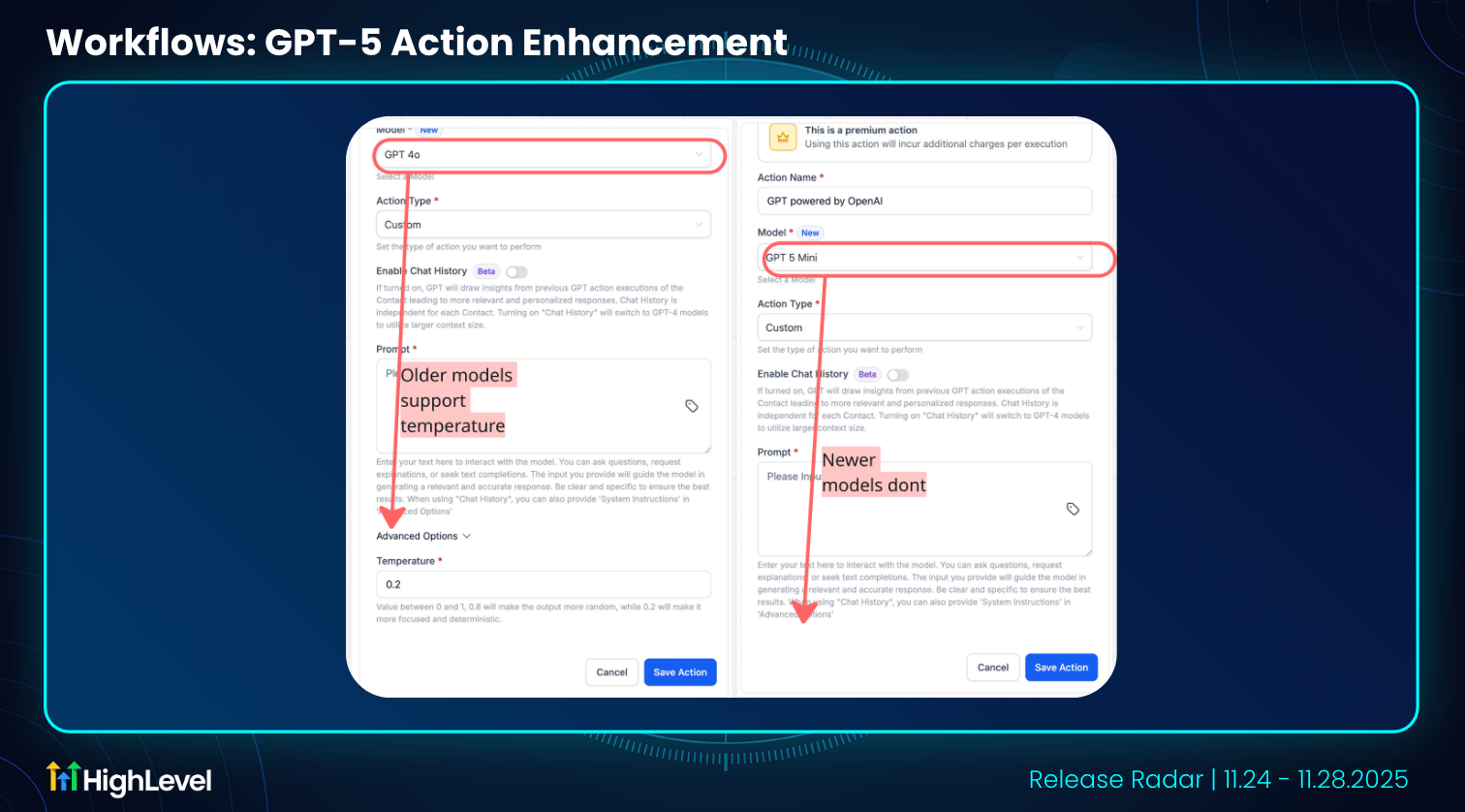
When using any of the newer models mentioned below , the Advanced Options section with temperature is now hidden:
GPT-5
GPT-5 mini
GPT-5 nano
GPT-5.1
📺 Want the Full Feature Breakdown? Watch the full video below 👇️ 👇️👇️
View Google Presentation Slide Deck HERE.

Upcoming HighLevel Events
HighLevel Local Hangout | Nashville, TN | December 3rd
RSVP HERE
HighLevel Local Hangout | Dallas, TX | January 13th
RSVP Form Coming Soon
HighLevel Local Hangout | Las Vegas, NV | January 14th
RSVP Form Coming Soon

Alright Be Honest, How’d I Do?
Your opinion matters to me.
Seriously. I don’t write this newsletter because I’ve got nothing better to do.
I do it because I am hell bent on building REAL value for you.
Did this Dispatch deliver? Or should I call in an airstrike and start fresh?
Drop a comment or leave some stars
⭐️ ⭐️ ⭐️ Mission Accomplished – Tactical, tight, and ready for deployment
⭐️ ⭐️ Needs Reinforcements – Some hits, but it’s limping
⭐️ Mission Failure – Absolute FUBAR
Until next week,
Stay Frosty!
Michael
Reply