- Command Post
- Posts
- Dispatch #025 | The Half-Built Hotel and the Automation Mirage
Dispatch #025 | The Half-Built Hotel and the Automation Mirage
Why a manual MVP may beat your shiny automations (initially)

Mike Gorski
December 16, 2025
8 Min Read
“Build the hotel before you brag about the concierge bot.”
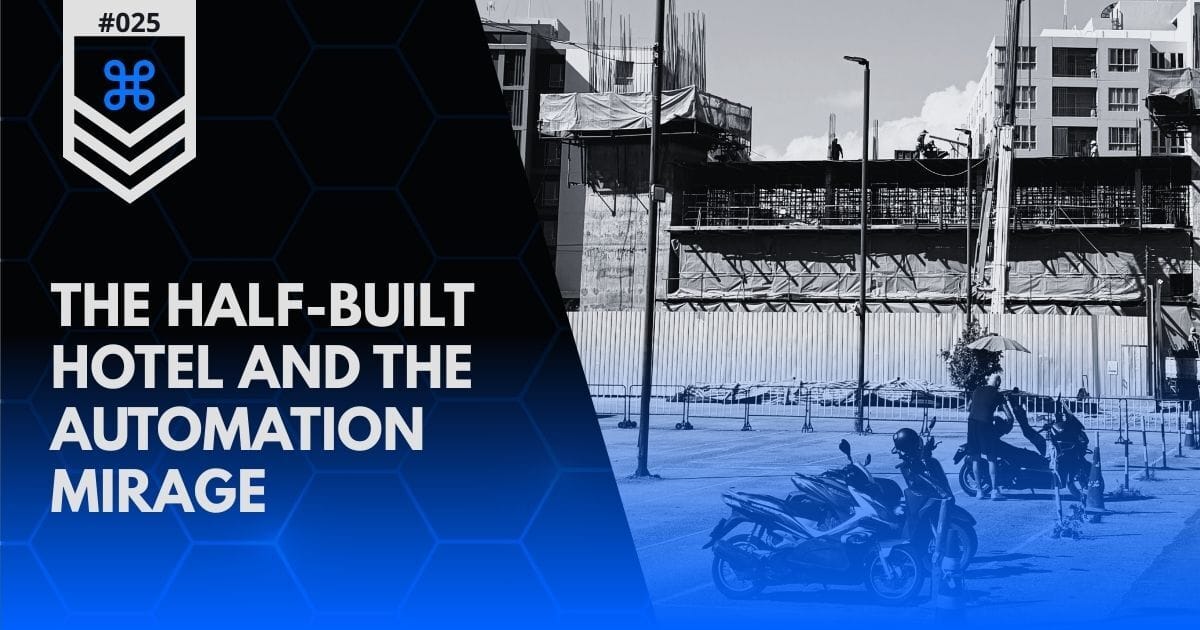
I’m staring at a half-built hotel while staying at a condominium complex in Chiang Mai. while writing this.
Concrete ribs, empty window frames, cranes sitting still in the heat.
No rooftop bar. No infinity pool. No tourists dragging roller bags through the lobby.
Just rebar, dust, and a developer praying the math works.
This is what real digital infrastructure looks like for a business. Silent, expensive and very unsexy.
Everyone wants the concierge bot. The AI receptionist, the fully automated funnel, the “I woke up to 47 booked calls while I slept” story.
Social feeds reward the screenshots of dashboards and the “look what my agent did while I was at brunch” flexes.
But in the real world, the first version that actually works usually looks like this:
A Google or Excel Sheet that someone updates by hand.
A human reading every inbound message and replying manually.
A founder living inside their own CRM like a raccoon in a dumpster, tagging, scoring, following up
The manual MVP creates truth.
It shows you how people actually move through your system, where they stall, what they ignore, what they are secretly willing to pay for.
Automation just moves that truth faster. If you wire the wrong thing, automation turns a small leak into a busted pipe.
Most inexperienced business owners underestimate the cost of building digital infrastructure.
They swipe their card for a software subscription and think they bought a hotel. In reality, they bought a piece of land and a permission slip to start pouring concrete. The real investment lives in:
Process mapping
System design
Manual testing
Training the humans who will either power or supervise the machines
During construction, the hotel makes exactly zero dollars.
No rooms rented. No upsells at the front desk. No wedding parties paying bar tabs. Just invoices, inspections, and delayed gratification.
Then opening day hits, guests start checking in, and the math finally starts to flip. The same pattern holds for digital infrastructure. That’s the tension this dispatch tackles.
In a market obsessed with automation, AI agents, and “set it and forget it,” how do you decide when to stay manual on purpose, and when to finally wire in the machines?
This week, we go into the trenches with a break down of the real cost of building digital infrastructure and show where manual execution wins the battle long before automation enters the war room.

“If you don’t understand how something is built, you don’t understand the cost of changing it later.”
TL;DR | Quick Brief Links

Mission Debrief: The Gun-Shy Technician
This one came in through a referral, the kind that usually signals “serious business owner, ready to level up,” so Jazmin took the discovery call.
On paper, it sounded straightforward.
She owns a medical practice. She wants her EMR system integrated with HighLevel.
She wants cleaner workflows, better follow-up, tighter ops.
Then the friction surfaced.
Her EMR wasn’t a mainstream platform and not anything with an established integration ecosystem. She picked it because she liked a few technical features. Fair enough.
When we walked through what it would actually take to make that EMR talk cleanly to HighLevel regarding APIs, custom logic, and long-term maintenance we gave her two responsible options:
Switch to a more widely supported EMR with existing integration paths.
Keep her current EMR and bring in a specialized third-party developer from the HighLevel ecosystem who could build and maintain the integration correctly.
That’s when the wall went up. She didn’t want to switch. She didn’t want to pay what it would actually cost and she has a difficult time trusting service providers.
She’d been burned before. Overpromised. Underdelivered. Passed around between vendors who sold dreams and left work incomplete.
And here’s the part that matters, trauma is real.
Here’s where we don’t sugarcoat it. Trauma from bad service providers does not eliminate the laws of effort, cost, and complexity.
Being gun-shy makes sense. Being cautious is rational. But refusing to invest doesn’t magically make complex integrations simple.
Now, you can absolutely invest in building an initial MVS (Minimal Viable Solution). I recommend it. But once you ask for custom digital infrastructure with all the bells and whistles, you better be ready to pull out your wallet.
At that point, the bill comes due in 3 scenarios:
Pay the professional rate and get it done right the first time
Hire a cheaper provider and paid later when the system breaks under growth
Do it yourself
Simple decision to make.
✅ What The Operator Did:
Empathized and educated the business owner on what the REAL cost and time investment is going to be based on the business needs
Provided the contact information to the 3rd Party Developer who can assist with EMR integration (if this business owner decides to move forward)
🔥 Tactical Takeaways (For Business Owners & Internal Teams)
Your past scars are valid but they are not a business plan.
Tool selection is an infrastructure decision, not a taste preference.
Cheap systems become expensive when they need to scale or integrate.
Walking away from misaligned builds is a sign of maturity, not lost revenue.

I would like to say that discovery call was an outlier, but it wasn’t.
Across industries, across niches, across maturity levels, the same pattern continues to resurface. Business owners oscillating between manual chaos and automation disappointment, never fully committing to either.
They delay infrastructure because it feels expensive. They rush automation because it feels sophisticated and then they blame the tools when neither delivers the outcome they imagined.
What’s missing is not intelligence. It’s cost literacy.
Most inexperienced business owners dramatically underestimate what digital infrastructure actually is.
They budget for items like software subscriptions with shiny AI features but fail to budget for components that are critical in supporting and growing the enterprise such as:
Process design
Data hygiene
System interoperability
Ongoing maintenance
Human oversight
Infrastructure lives below the waterline and oftentimes looks like nothing is happening while everything important is being built.
Just like that hotel. No rooms rented equals no revenue photos. It’s merely concrete curing and inspectors arguing over load-bearing walls.
This is why having a manual MVS in the beginning is the right move.
Manual execution with minimal automation works because it forces contact with reality.
You learn:
Where people hesitate
What they misunderstand
What they are willing to pay for
What breaks when volume increases
Manual systems expose truth. Full automation amplifies whatever truth already exists.
If the process is wrong, automation makes it wrong faster. If the economics are broken, automation scales the loss.
This is why disciplined teams stay manual longer than feels comfortable. Not because they fear automation, but because they respect it.
Here’s the part nobody likes to hear, “Digital infrastructure is front-loaded pain for back-loaded leverage.
You pay first in:
Time
Attention
Capital
Then if you built it correctly you will eventually you earn back:
Speed
Predictability
Margin
Optionality
The businesses that survive this phase look slow to outsiders. The businesses that skip it look impressive right before they collapse.
So keep in mind, the market is loud right now. AI everywhere. Automations everywhere. Promises everywhere.
But inside the wire, the reality is much quieter and more expensive than most people are prepared for.
With that being said, this is how durable businesses are actually built.

Time for your recon drop.
This is Actionable Intelligence that matters, globally and inside the HighLevel war room.

The Mouse Just Signed the Check
OpenAI shipped their newest model.
GPT-5.2 is now live and it is OpenAI’s most capable model to date.
Released as a three-headed weapon system:
Instant: Optimized for speed and responsiveness
Thinking: Built for complex, multi-step reasoning
Auto: Decides which mode to use without asking permission
At the same time, OpenAI signed a three-year licensing and equity deal with Disney that quietly redraws the map.
Here’s what actually matters:
Disney becomes OpenAI’s first major content licensing partner for Sora, the short-form generative video platform
Sora can now generate fan-prompted videos using 200+ Disney, Pixar, Marvel, and Star Wars characters
Select Sora-generated content will stream directly on Disney+
Disney deploys ChatGPT internally and builds new consumer products using OpenAI APIs
Disney invests $1 billion in OpenAI, with warrants for more equity
This isn’t a pilot. This is a balance-sheet commitment.
Why This Matters (For Operators & Small Business Owners)
When the world’s most IP-defensive company licenses its characters to a generative AI platform with explicit guardrails around creator rights and safety it signals institutional acceptance.
AI has officially crossed from “interesting tool” into core infrastructure for storytelling, labor, and production.
Resources:
The Walt Disney Company and OpenAI reach landmark agreement to bring beloved characters from across Disney’s brands to Sora
Advancing science and math with GPT-5.2

Here are my top three choices from this week’s feature drop.
Voice AI: Multi Calendar Appointment Booking
AI agent can now seamlessly manage appointments across all your calendars. This is perfect for businesses that offer different types of services, have multiple team members, or need to separate appointment categories.

Workflows: Inbound DND Triggers and Actions
Enabling this feature will now block incoming spam calls and avoid creating junk contacts and false opportunities in the CRM.

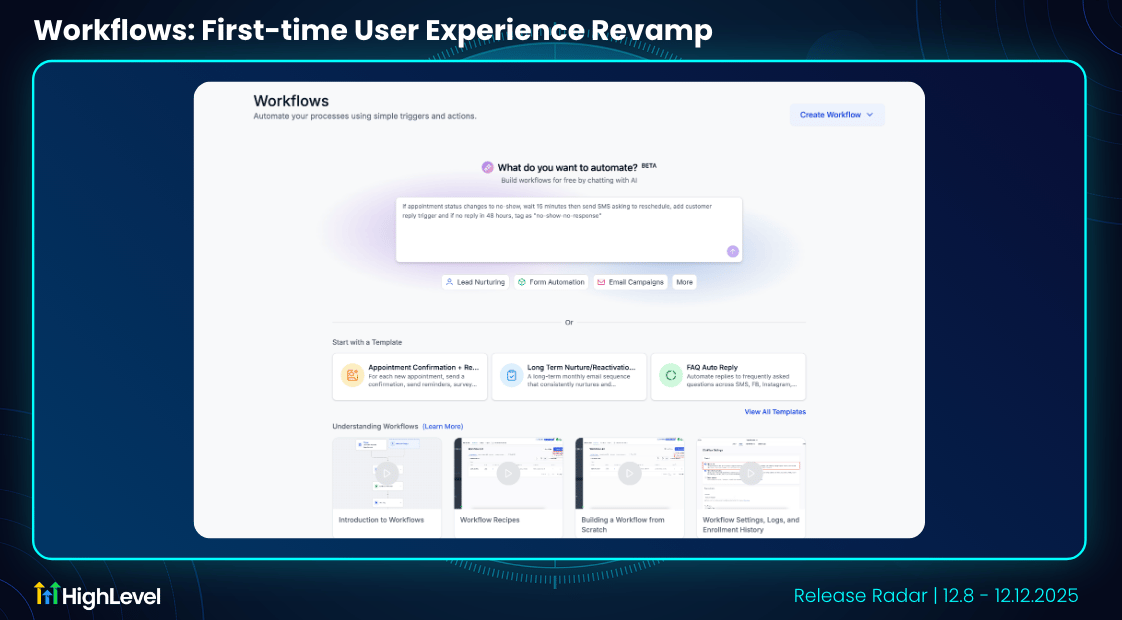
Workflows: First time user experience Revamp
The new landing page puts the power of AI front and center while giving users clear paths to get started, whether they prefer AI assistance, pre-built templates, or building from scratch.
📺 Want the Full Feature Breakdown? Watch the full video below 👇️ 👇️👇️
View Google Presentation Slide Deck HERE.

Upcoming HighLevel Events
HighLevel Local Hangout | Dallas, TX | January 13th
RSVP Form Coming Soon
HighLevel Local Hangout | London, UK | January 21st
RSVP Form Coming Soon

Alright Be Honest, How’d I Do?
Your opinion matters to me.
Seriously. I don’t write this newsletter because I’ve got nothing better to do.
I do it because I am hell bent on building REAL value for you.
Did this Dispatch deliver? Or should I call in an airstrike and start fresh?
Drop a comment or leave some stars
⭐️ ⭐️ ⭐️ Mission Accomplished – Tactical, tight, and ready for deployment
⭐️ ⭐️ Needs Reinforcements – Some hits, but it’s limping
⭐️ Mission Failure – Absolute FUBAR
Until next week,
Stay Frosty!
Michael
Reply